
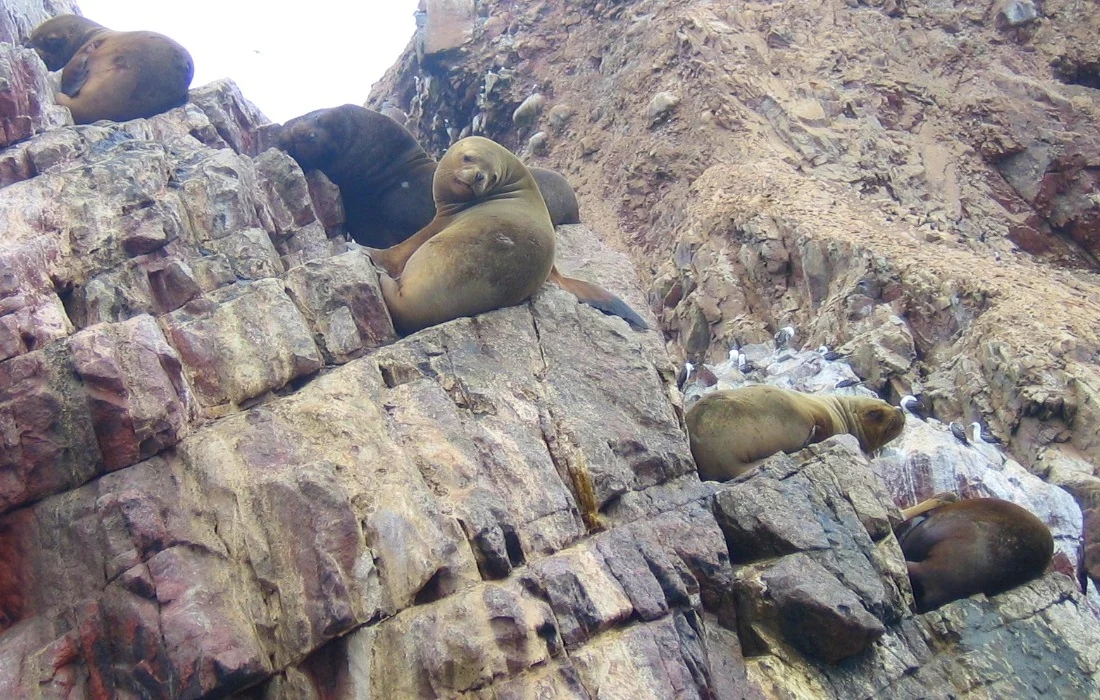
Ballestas islands animals: species and viewing expectations
Understand sea lions, penguins and seabird colonies at Ballestas, with identification clues and limits on promised sightings.

BallestasIslands.com is an independent travel guide. We are not SERNANP, a reserve authority or a tour operator.
Look for sea lions on low rocks, penguins on ledges and birds both overhead and on the islands. Keep the offshore trip distinct from a mainland birdwatching visit. A species recorded in the wider reserve system is not certain to appear on your sailing. Stay seated when asked, use binoculars without leaning out and never feed or call animals closer.
On this page8
Ballestas Islands animals include sea lions, Humboldt penguins and large groups of seabirds. The boat gives you a view of their rocky home from the water. It does not deliver a fixed set of sightings. Learn a few shapes before you go, then let the guide help you with birds that are too distant to name.
Animals and the views a boat can give
The clues help with observation. Presence in the area does not guarantee a sighting on a departure.
Details for each option
Animal or bird group: Sea lions
- First feature to look for
- Broad bodies resting near the water or moving through it
- Limit from a moving boat
- Posture and distance can hide detail
Animal or bird group: Humboldt penguins
- First feature to look for
- Upright body and dark-and-white pattern
- Limit from a moving boat
- A small bird can merge with the rocks
Animal or bird group: Guanay cormorants
- First feature to look for
- Dark upper body and pale front in adults
- Limit from a moving boat
- Many birds can overlap in a colony
Animal or bird group: Peruvian boobies
- First feature to look for
- Pale head and pointed bill
- Limit from a moving boat
- Young birds can look different
Animal or bird group: Inca terns
- First feature to look for
- Dark body and pale facial marking in adults
- Limit from a moving boat
- Fine marks need a clear view
Sources and limits are explained in the guide · · Table by Ballestas Islands
Ballestas Islands animals at a glance
The islands are part of the National Reserve System of Islands, Islets and Guano Points, known as RNSIIPG. SERNANP's Ballestas conservation report identifies sea-lion colonies and Humboldt penguins here. Checked October 2026. A report about the place establishes that context, not how many animals you will see.
Start with groups you can recognise. A sea lion has a very different body shape from a bird on the same rock. Penguins stand more upright than many nearby seabirds. For a distant flying bird, the useful first observation may simply be its size and the way it moves.
The bird descriptions draw on the official protected-area bird guide, published in 2014. It is a useful identification reference. Its old threat labels and travel details should not be treated as live information.
Sea lions: watch the whole colony
Look at where the animals sit in relation to the water. Some may rest while others move between rocks and sea. You do not need a close portrait to enjoy that pattern. A wider view often shows more of how the animals use the place.
Do not infer a breeding stage from a single pose or size difference. Ask the guide what can be said from the view you have. A guide may point out a feature that is hard to see in your photo, or explain why the identification remains uncertain.
Keep the boat as the viewing place. Never ask for a closer approach that disturbs resting animals. A quieter look from the permitted route serves the visit better than movement staged for a camera.
This guide does not assign a guaranteed sea-lion count or a best day for a particular scene. Those would need dated, local evidence. The fact that a colony lives here cannot promise which rocks are occupied on one outing.
Penguins and birds use different clues
The penguin guide focuses on the Humboldt species. Look for the body outline first. A black-and-white bird on a rock is not enough by itself to settle every identification.
For offshore birds, begin with bill, body shape and behaviour. A bird diving to feed presents different clues from one resting with its head tucked in. Colour can be hard to judge against glare or shaded rock.
Try to describe what you can see before reaching for a name. Note whether the bird is alone or in a group and whether it swims, perches or flies. Those observations help a guide far more than a confident guess based on a blurred crop.
If a bird stays too distant, leave it unnamed. Enjoying the scene does not require adding every shape to a life list. A broad record such as “large group of dark seabirds” is more honest than a precise species name you cannot support.
Habitat and seasonal uncertainty
Food, sea conditions and the animals' own movements affect what is in view. A photo from a previous year records that visit. It does not show the current size of a colony or establish the same viewing position for your boat.
The SERNANP reserve-system account covers a long chain of places along Peru's coast. Its full species list is wider than Ballestas. Do not turn each species named there into a promised local sighting.
Ask about current access and wildlife instructions before departure. A seasonal travel slogan such as “best for animals” needs more detail. It may refer to one species, a local event or simply a seller's preferred travel month.
Choose the trip for the island setting and wildlife watching as a whole. That leaves room to enjoy an unexpected bird without treating a missed penguin photo as a failed outing. No operator controls where a free-living animal rests.
View wildlife without changing its behaviour
Keep food packed away and take waste back to shore. Do not feed animals to bring them closer. Avoid calling, clapping or playing sounds to trigger a response. Follow crew instructions when the boat changes position.
Use a camera strap and keep hands and equipment inside the boat. Ask before standing for a photo. Let other passengers have a view without leaning across them or blocking the guide.
If an animal looks injured or unwell, tell the guide. Do not touch it or ask the crew to bring it aboard for a photograph. The relevant authority should decide any response.
Take binoculars if you can use them comfortably from a moving seat. A modest view that stays steady can be more useful than excessive magnification. Keep some time simply to watch without a screen.
Mainland wildlife is a different visit
For flamingos, plan a shore-based habitat visit rather than assuming an island boat will pass them. The flamingo guide explains that distinction. The Paracas bird guide looks at mainland settings and the limits of old location records.
The wider reserve wildlife guide separates sea, shore and desert. Those habitats are not all covered by a single island outing. Choose the visit that matches the animals you want to understand, with current access checked for each stop.
Continue with the related guide
Verdict on seeing Ballestas Islands animals
Book to watch Ballestas Islands animals in their coastal setting, with room for uncertain sightings. Learn a few clear features and let distant birds stay uncertain. Use the boat trip comparison to check the departure, then enjoy the wildlife without asking the crew or animals to perform for the itinerary.