
Paracas birds: mainland habitats and birdwatching guide
Choose mainland Paracas birdwatching by habitat, with identification clues, historical location notes and current access checks.

BallestasIslands.com is an independent travel guide. We are not SERNANP, a reserve authority or a tour operator.
For mainland birdwatching, plan permitted shore stops and enough time to watch. The official Paracas guide describes gulls, terns, cormorants and other birds in distinct habitats. Its old location notes are not current access permits. Use a guide or reserve staff for today's route, and keep a dated record separate from a promise of future sightings.
On this page8
Paracas birds use several settings: shallow bays, beaches, rocky shore and the wider desert edge. A mainland birdwatching visit is different from the Ballestas island boat. Choose the habitat and amount of observation time first. Then use clear features and current local guidance to decide which species you can fairly record.
Match the bird to the habitat
Mainland shores and offshore colonies offer different views. Choose the route for the habitat.
Details for each option
Bird or group: Belcher's gull
- A feature to check
- Adult bill pattern and overall gull shape
- Habitat context and limit
- Shore setting helps, but plumage changes with age and season
Bird or group: Inca tern
- A feature to check
- Adult pale facial curl on a dark head
- Habitat context and limit
- Fine marks need a clear view
Bird or group: Guanay cormorant
- A feature to check
- Adult pale front against dark upperparts
- Habitat context and limit
- Birds can also be seen offshore; location alone does not identify one
Bird or group: Surf cinclodes
- A feature to check
- Brown coastal bird working rocky edges
- Habitat context and limit
- Compare the whole bird, not a brief brown blur
Bird or group: Chilean flamingo
- A feature to check
- Long-legged flock shape with a species check
- Habitat context and limit
- Suitable shallow habitat does not guarantee a flock
Sources and limits are explained in the guide · · Table by Ballestas Islands
Paracas birds by mainland habitat
The official protected-area bird guide gives the most useful starting structure. Published in 2014, it describes Paracas birds by appearance and habitat. Checked October 2026. Its travel times and old status labels are not used here as current facts.
Think about where the bird is feeding or resting. A gull on a beach, a bird close to wave-washed rock and a flock in shallow water present different viewing tasks. The setting can narrow the possibilities without proving the final name.
For example, a dark-and-white bird close to the water may be a gull or another coastal bird. Look at the bill, legs and body shape before naming it. A small number of useful features can beat a confident guess from colour alone.
Identification reference
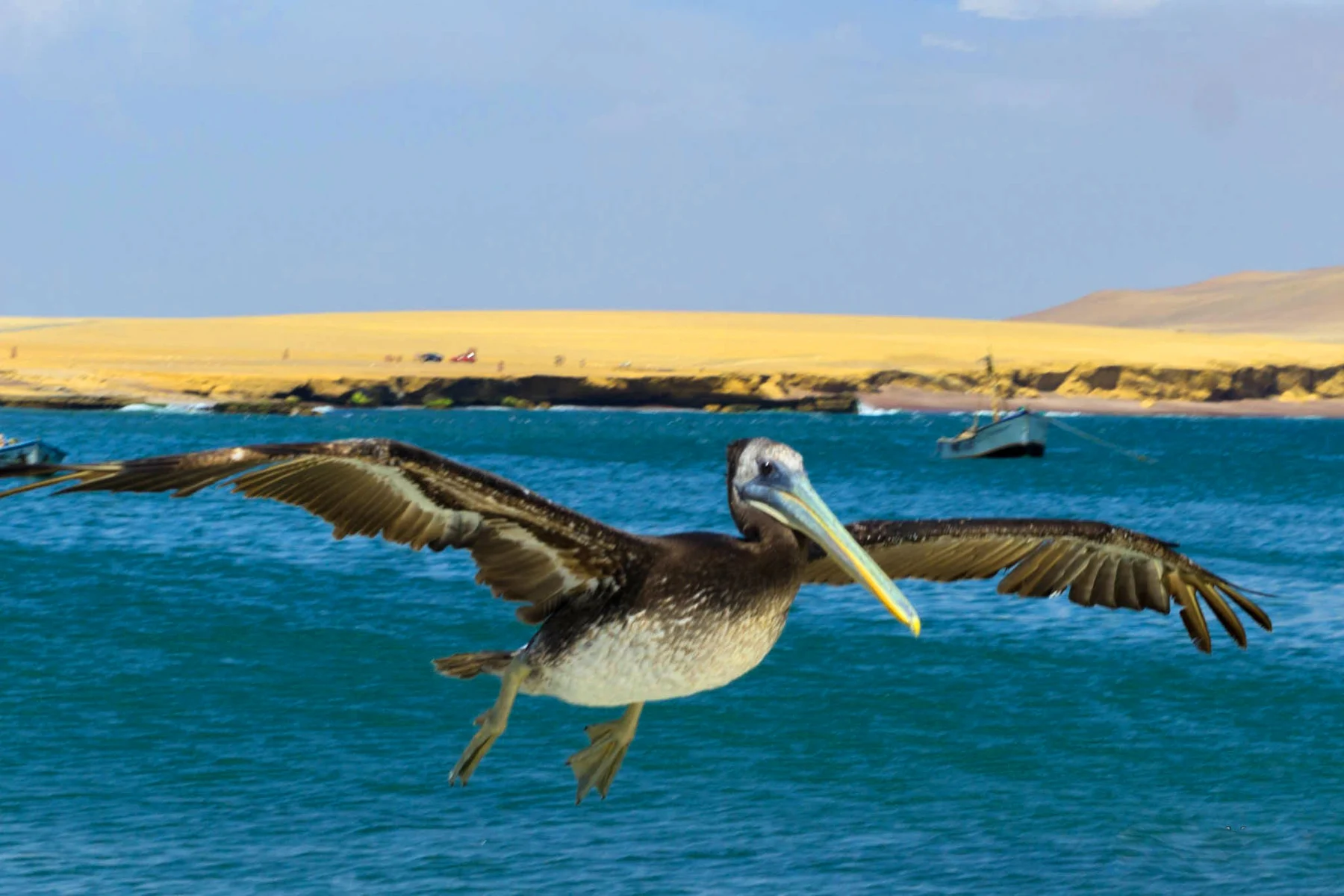
The photographed pelican in the hero shows a real Paracas scene. Its credit identifies the source. It is not evidence that a bird will pass your chosen viewpoint at the same distance.
For flamingos, use the dedicated habitat guide. For island birds, use the offshore reference. Keeping those pages distinct helps you choose the right trip.
Verified historical viewing areas and current access
The 2014 guide names places around Paracas Bay, Cequión and Lagunillas for different coastal birds. Those names are historical birdwatching references. They do not establish that every approach or parking place remains open today.
Before leaving, ask reserve staff about permitted viewing points and any temporary restriction. Explain whether you want a short scenic stop or time with a scope. A route designed for a general sightseeing group may spend less time at the habitat than you want.
Do not walk across a shore just because an old checklist used that place name. The observer may have had different access or recorded the bird from somewhere else. A broad location label often covers more than a single safe approach.
The SERNANP visitor page is a useful authority contact route. Checked October 2026. Use current local instructions for the stop itself. Do not infer today's permission from a long-lived web page.
Observe before you name the bird
Take a few moments to watch without photographing. Note the bird's size relative to nearby birds and the shape of its bill. See whether it wades, swims, dives or searches rocks. Those observations build a better basis for identification.
If you use binoculars, find a fixed feature first. A rock or shoreline shape helps you return to the bird after adjusting focus. Avoid pointing vaguely at a large stretch of water when explaining a sighting to someone else.
For a photograph, keep one image wide enough to show habitat. A close crop can hide useful context. Do not edit the scene in a way that makes the bird appear to have been much closer or on a different part of the coast.
Leave uncertain records qualified. “Possible Inca tern” carries a different claim from a confirmed identification. A guide may help resolve it, but a name should follow the evidence rather than the wish to complete a list.
Access and observation etiquette
Stay on the permitted route and follow signs or staff instructions. Use optics instead of closing the distance on a feeding group. Do not make birds fly for a photograph or enter a closed area for a clearer background.
Keep enough space for other visitors and road users. A roadside bird is not a reason to stop a vehicle unsafely. Agree stops with the driver, who must choose a suitable place under the current rules.
Take food waste and wrappers away. Do not feed birds near restaurants or viewpoints. A repeated feeding scene can change behaviour and make a poor model for other visitors.
If a bird seems unwell, tell the guide or reserve staff. Do not pick it up or approach for a closer picture. The responsible authority should decide the response.
Seasonal records and their limits
Bird records have a place and a date. A sighting in a given month tells you that it happened, not that it repeats every year. A broad seasonal pattern still leaves uncertainty on a short visit.
SERNANP's Paracas account lists notable reserve birds. Its area-wide context is broader than any one stop. Do not turn the whole list into a guarantee from a guide.
For a current species status, use a dated assessment for the correct scientific name. Older national and global labels can differ. A regional occurrence note is not a population estimate.
Ask a supplier to describe its recent evidence if a particular bird is the main reason for booking. A dated local observation is useful, but it remains a past event. The honest promise is a visit to appropriate habitat under current access rules.
Mainland versus offshore birdwatching
Choose mainland stops for time around shore habitats and room to observe from land. Choose Ballestas for the offshore rocks and colonies viewed from a boat. You can enjoy both, but they require separate timing and access decisions.
The wider animal guide helps place those choices together. The reserve wildlife page adds other habitats without treating them as one compact zoo.
For a land outing, compare the reserve tour formats and ask about actual observation time. The number of listed stops is less useful than whether the route serves your birdwatching interest.
Verdict on watching Paracas birds
Choose Paracas birds by habitat, current access and time to observe. Use the old field guide for identification clues, with current evidence for the route. A smaller set of well-supported sightings is more useful than a long list built from uncertain shapes and promised birds.